How to choose a rechargeable mushroom lamp
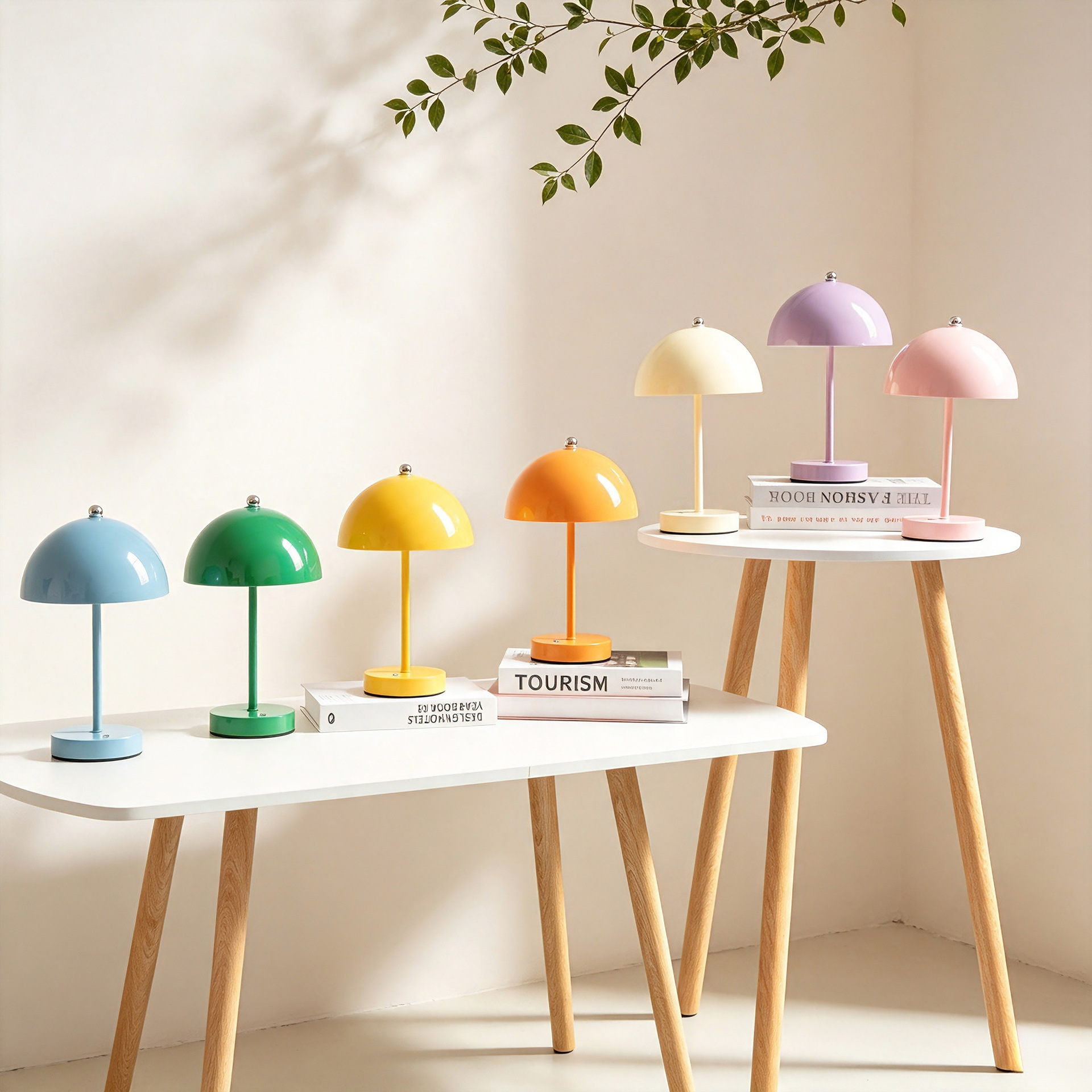
Choose a rechargeable mushroom lamp whose shade and base fit the table and whose charging routine suits your use. Compare the linked designs by their own runtime and controls before choosing the finish.
By LIRRA · Updated
Catalogue desk research; selection is based on documented features and the stated household task. No hands-on testing.
Mark the full shade outline
Include the widest part of the mushroom shade as well as the base. Sit beside the proposed position and look across the table. Leave enough room to reach the control and lift the lamp out for charging.
Compare the linked durations
The floral metal lamp runs for 6–7 hours and charges in 3–4 hours through USB-C. It offers touch dimming and bright or pastel finishes.
The other linked mushroom lamp has stepless dimming, a 20-hour runtime and a 2-hour charging time. Its finish choices include metallic, wood-grain and black options.
Choose the everyday setting
Set the lamp beside the surface you want to light. Keep runtime conditions with the comparison when choosing a dimming setting. For a dining display, allow room for plates and a clear seated view.
Plan a charging place
Keep the connector or lamp removal route accessible. Follow the charging instructions for the selected version and return it to the same place between uses.
Questions and answers
How long does the floral lamp run?
Its runtime is 6–7 hours.
How is it charged?
It uses USB-C and charges in 3–4 hours.
What is the other mushroom lamp's runtime?
Its runtime is 20 hours.
Can I dim both linked designs?
Both linked designs offer dimming.
What should I measure?
The full shade and base outline, with space for controls and removal.
Evidence and method
Based on a saved catalogue snapshot of 943 small-light models. Product details are taken from recorded specifications and checked for implausible values. Counts describe source records, not current stock.